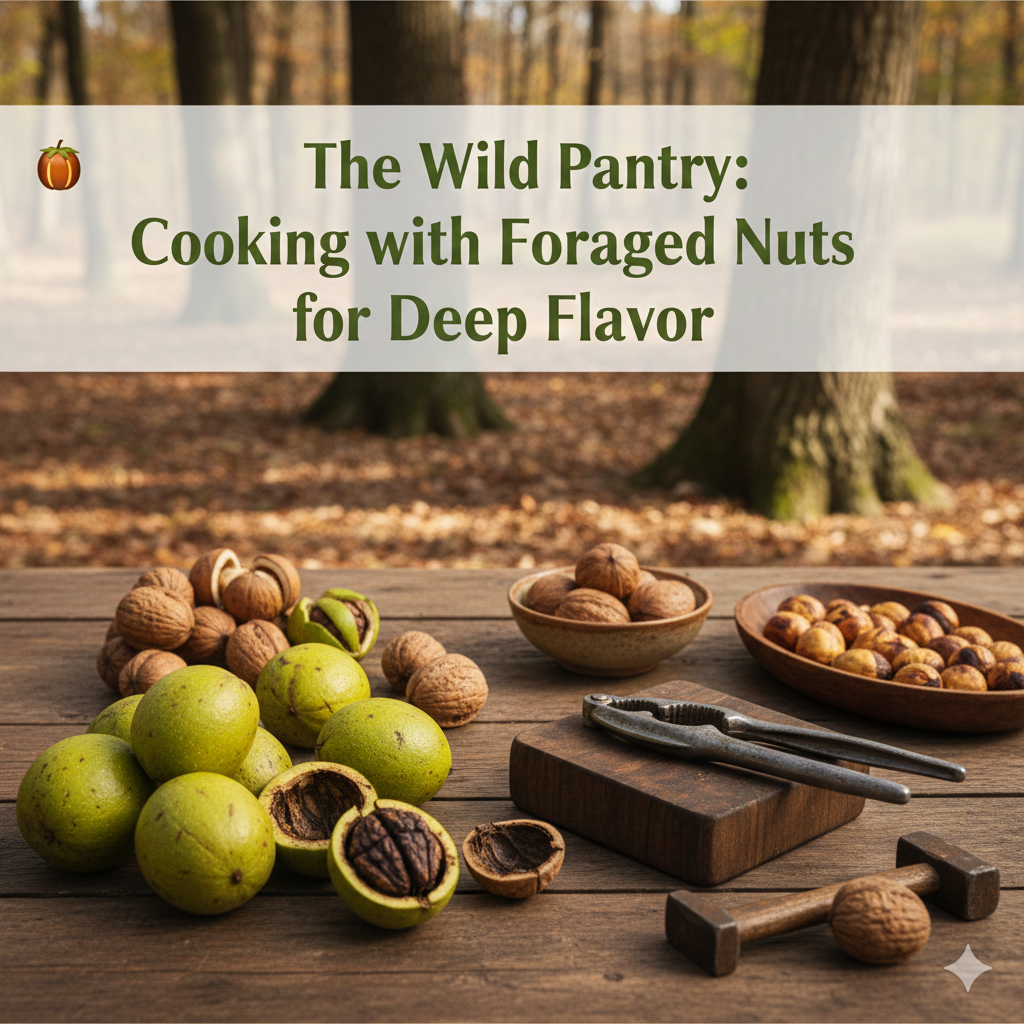
There is a quiet satisfaction that comes from foraging nuts. You are tapping into an abundant, natural food source that has sustained people for thousands of years.
Imagine the deep, unmistakable aroma of freshly shelled black walnuts or the buttery richness of wild hickories. These flavors are worlds away from the bland, standardized nuts you find at the grocery store.
The season for nut foraging—usually late summer through fall—is a true gift from nature, offering high-energy, deeply flavorful ingredients.
This guide will show you how to safely identify, harvest, and process these tough-shelled treasures, finally bringing these incredible wild flavors into your kitchen.
🐿️ Why Forage and Cook with Wild Nuts?
Wild nuts offer a nutritional punch and a flavor complexity that cultivated varieties often lack. This makes them a culinary secret weapon.
Black walnuts, in particular, have a bold, pungent, and earthy flavor. They elevate baked goods and savory sauces with an intensity that commercial walnuts simply cannot match.
Furthermore, foraging nuts is one of the most sustainable forms of wild ingredient harvesting. You are simply gathering what the tree has already dropped, leaving the tree itself unharmed.
It requires patience, but the rewards are intensely flavorful, nutrient-dense ingredients that are completely free and local.
🌳 Identification and Harvest: Finding Your Treasure
Knowing what to look for and when to look for it is crucial when foraging nuts. The best time is right after the first frost, when the outer husks begin to split.
🔎 Key Species for Beginners
- Black Walnut (Juglans nigra): Easily identified by its round, thick, green-yellow husk that stains everything a deep brown. The inner nut has an extremely hard, bumpy shell and a powerfully flavored meat.
- Hickory Nuts (Carya species): These are lighter in color than black walnuts. The husk is generally thicker and splits neatly into four distinct sections when ripe, revealing a smooth, hard nut inside.
🍂 Harvesting and Curing
Collect the nuts directly from the ground—never shake a tree! Pick ones that are fully enclosed in their husks or have recently dropped.
After gathering, you must remove the outer husk. For walnuts, this is messy! Wear gloves to avoid staining your hands. You can roll them under a boot or use a dedicated hulling tool.
Once the husks are off, you must cure the nuts. Spread the in-shell nuts in a single layer in a cool, dry, well-ventilated space for two to six weeks. This process ensures the meat dries properly and the flavor develops fully.
🔨 Essential Processing: Getting to the Good Stuff
The biggest hurdle with wild nuts is cracking the extremely hard shells, especially those of the black walnut.
1. Cracking the Shell
Standard nutcrackers are often insufficient. You will likely need heavy-duty tools, such as a hammer or a dedicated, lever-action nutcracker.
Place the nut on a stable surface (like an anvil or a strong wooden board). Strike the nut firmly but precisely to split the shell without pulverizing the meat inside.
2. Shelling and Cleaning
After cracking, the nutmeats (or “kernels”) must be picked out. This is a time-consuming but essential step.
The nutmeats will often still have bits of shell or dried husk clinging to them. Soak the kernels briefly in warm water—about 15 minutes—to loosen any debris.
Skim off any floating debris and then dry the nutmeats thoroughly on a baking sheet lined with paper towels before storing or using.
🥧 Step-by-Step Guide: Roasting Wild Nut Meats
Roasting dramatically enhances the flavor and crispness of wild nuts, making them perfect for both cooking and snacking.
Ingredients:
- 1 cup shelled and cleaned wild nutmeats (hickory or black walnut)
- 1 teaspoon neutral oil (grapeseed or canola)
- Pinch of fine sea salt
Instructions:
- Preheat and Prep: Preheat your oven to a low temperature, around $300^\circ\text{F}$ ($150^\circ\text{C}$). Spread the cleaned, dried nutmeats in a single layer on a rimmed baking sheet.
- Add Fat and Salt: Drizzle the nuts with the oil and sprinkle with a pinch of salt. Toss everything gently to ensure an even coating. The oil helps draw out the flavor and provides even browning.
- Roast Slowly: Place the tray in the preheated oven. Roasting low and slow is key to prevent burning the outer edges while the center remains raw.
- Monitor Carefully: Roast for 8 to 15 minutes, depending on the nuts’ size. Begin checking for doneness after the 8-minute mark.
- Check for Doneness: The nuts are ready when they are lightly golden brown, smell intensely fragrant, and have a firm crunch when sampled.
- Cool and Store: Remove the tray from the oven and transfer the nuts immediately to a cool plate or wire rack to stop the cooking process. Once completely cool, store them in an airtight container.
🍽️ Cooking with Wild Nut Flours
Beyond snacking, roasted wild nuts can be ground into a delicious flour. This is an excellent, gluten-free addition to baking.
- Black Walnut Flour: Due to its intense flavor, use this sparingly. Replace about 1/4 of the wheat flour in robust recipes like brownies, dark chocolate cakes, or savory crusts.
- Hickory Nut Meal: Use the finer grind as a crust for chicken or fish. The buttery flavor complements seafood wonderfully.
✅ Conclusion: The Ultimate Wild Flavor
Cooking with foraged nuts is an exercise in dedication, from the initial harvest to the final crack. However, that intense, unadulterated flavor you unlock is a direct reward for your effort.
Once you taste the deep, earthy richness of a black walnut you’ve processed yourself, you’ll never look at a store-bought nut the same way again. It’s a truly authentic taste of the wild pantry.
Ready your hammer, and happy foraging!
❓ Frequently Asked Questions (FAQ)
Q1: What is the most important tool for foraging wild nuts?
Beyond gloves for black walnuts, the most important tool is a reliable, heavy-duty cracking device, as standard household nutcrackers often fail on the dense shells of wild varieties.
Q2: How do I store shelled wild nuts for the long term?
Shelled, dried nutmeats should be stored in an airtight container, ideally in the refrigerator for up to 6 months, or in the freezer for up to one year to maintain freshness and prevent rancidity.
Q3: Can I use wild nuts in the shell right after I harvest them?
No. After harvesting and hulling, nuts must be cured (dried) for several weeks. Attempting to crack them too soon results in damp, rubbery nutmeats that are difficult to remove and prone to spoilage.
Q4: Are all hickory nuts edible?
Most hickory nuts are edible, but the flavor and ease of shelling vary wildly. The shagbark and shellbark hickories are the most prized for their large, sweet kernels. The pignut hickory is edible but often too bitter to be worthwhile.
Q5: How do I prevent my hands from staining when hulling black walnuts?
Black walnut hulls contain a potent black dye. Always wear heavy-duty rubber or disposable gloves when handling the husks, and process them away from porous surfaces like wood or concrete.
Q6: What is the difference between hickory nuts and pecans?
Pecans are actually a type of hickory nut. They are generally easier to crack and have a thinner shell than most other species, which is why they are the most commercially popular.